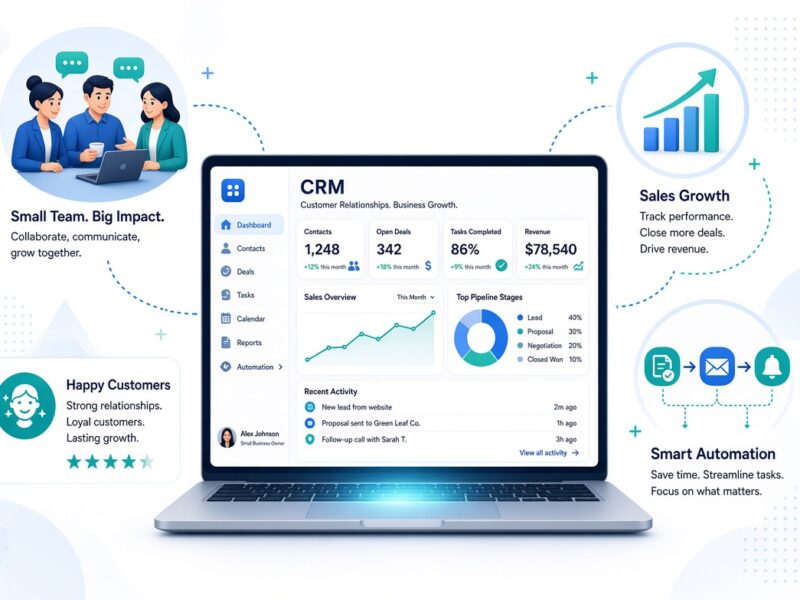
Customer Relationship Management (CRM) is no longer optional. In 2026 it has become the operational backbone of nearly every growth-oriented business.
91% of companies with 10 or more employees now use a CRM system. Businesses that implement one effectively see an average return of $8.71 for every dollar spent. Sales teams report productivity lifts of around 29%, and customer satisfaction improves for nearly half of users.
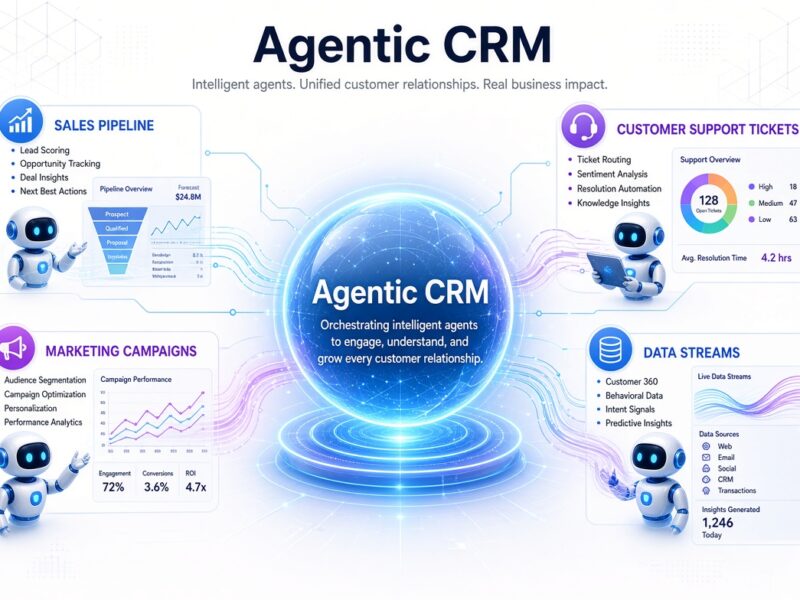
The global CRM market is projected to reach approximately $126 billion in 2026 and is on track to exceed $300 billion by the early 2030s. The biggest shift this year is the move from traditional CRM into agentic AI — systems that don’t just store data but take autonomous action across sales, service, and marketing.
This complete guide covers everything you need to know: what CRM really is, the different types, core features that matter in 2026, proven benefits, how to choose the right platform, implementation best practices, and the trends that will define the next three years.

What Is CRM? A Clear Definition for 2026
CRM stands for Customer Relationship Management. It is both a business strategy and a technology platform.
As a strategy, CRM focuses on understanding every customer interaction across the entire lifecycle — from first awareness to long-term loyalty and advocacy.
As technology, a CRM system is the centralized software that captures, organizes, analyzes, and activates customer data so sales, marketing, and service teams can work from the same source of truth.
Modern CRM platforms go far beyond contact databases. In 2026 they combine:
- Real-time customer profiles
- Sales pipeline management
- Marketing automation
- Customer service tools
- Advanced analytics
- Generative and agentic AI
The result is a single system that helps companies deliver personalized experiences at scale while improving internal efficiency.
The Three Core Types of CRM
Understanding the different types of CRM helps you choose the right approach for your business.
1. Operational CRM
This is the most common type. It automates and streamlines day-to-day customer-facing processes:
- Lead and opportunity management
- Sales automation
- Marketing campaign execution
- Customer service ticketing and case management
2. Analytical CRM
Analytical CRM focuses on turning data into insights. It uses reporting, dashboards, predictive analytics, and AI to answer questions such as:
- Which customers are most likely to churn?
- Which leads have the highest probability of closing?
- What is the true lifetime value of different customer segments?
3. Collaborative CRM
Collaborative CRM breaks down silos between departments and external partners. It ensures that sales, marketing, support, and even partners share the same customer context so every interaction feels consistent.
Most leading platforms in 2026 (Salesforce, HubSpot, Microsoft Dynamics 365, Zoho, Pipedrive, and others) combine all three types into a unified system.
Key Benefits of CRM in 2026
Companies that use CRM effectively consistently report measurable gains:
- Higher sales revenue — Average increases of 20–41% after proper implementation
- Improved productivity — Sales reps spend less time on data entry and more time selling
- Better customer retention — A 5% improvement in retention can boost profits by 25–95%
- Faster sales cycles — Many organizations shorten deal cycles by 8–14 days
- Lower customer acquisition costs — Better targeting and lead prioritization reduce wasted spend
- Stronger data-driven decisions — Real-time dashboards replace gut feeling
Perhaps the most important benefit in 2026 is the ability to deploy AI agents that handle routine tasks: lead qualification, follow-up emails, meeting scheduling, case routing, and even basic customer support conversations.
Essential CRM Features You Should Demand in 2026
Not every platform is equal. Here are the features that separate high-performing systems from outdated ones:
Contact & Account Management Complete 360-degree customer profiles with interaction history, preferences, and activity timelines.
Sales Pipeline & Opportunity Management Visual pipelines, stage tracking, forecasting, and deal intelligence.
Marketing Automation Email sequences, lead scoring, landing pages, and multi-channel campaign management.
Customer Service & Support Ticketing, knowledge base, omnichannel inbox (email, chat, social, phone), and AI-assisted responses.
Reporting & Analytics Custom dashboards, real-time KPIs, and predictive insights.
AI & Automation Layer Generative AI for content and email drafting, predictive lead scoring, and agentic AI that can take multi-step actions.
Mobile Access & Offline Capability Field teams and remote workers need full functionality on mobile devices.
Integrations & Open API Seamless connection with email, calendar, ERP, e-commerce, accounting, and communication tools.
Data Quality & Governance Tools Duplicate detection, enrichment, consent management, and AI data cleaning — because 76% of users still report that less than half of their CRM data is accurate and complete.
How to Choose the Right CRM for Your Business
Selecting a CRM is one of the highest-impact technology decisions a company makes. Follow this practical framework:
- Define your primary use case Sales-led growth? Service excellence? Marketing-heavy inbound? Hybrid?
- Map your current processes and pain points Where do deals get stuck? Where does customer context get lost?
- Set clear success metrics Examples: increase win rate by 15%, reduce average response time by 40%, improve forecast accuracy.
- Evaluate total cost of ownership Licenses + implementation + training + ongoing administration + integration costs.
- Prioritize ease of adoption The best CRM is the one your team actually uses every day.
- Test AI capabilities thoroughly In 2026, agentic AI is the differentiator. Ask vendors for live demos of autonomous workflows.
Popular platforms currently recognized as strong performers include Salesforce (especially with Agentforce), Microsoft Dynamics 365, HubSpot, Zoho CRM, Pipedrive, Monday.com CRM, and SugarCRM.
Implementation Best Practices That Actually Work
Many CRM projects fail not because of the software, but because of poor rollout. Follow these proven steps:
- Secure executive sponsorship early
- Start with a clear, limited scope (one team or one process)
- Clean and migrate only high-quality data
- Involve end users in configuration and testing
- Provide role-specific training (not generic platform tours)
- Establish data quality rules and ownership from day one
- Measure adoption weekly in the first 90 days
- Iterate based on real usage, not theoretical processes
Companies that treat CRM as a continuous improvement program rather than a one-time project achieve far higher ROI.
CRM Trends Defining 2026 and Beyond
Several forces are reshaping the category right now:
Agentic AI Systems are moving from “suggest next best action” to “take the next best action” with human oversight. Salesforce Agentforce, HubSpot Breeze, Microsoft Copilot agents, and similar tools are leading this shift.
Data Quality as a Competitive Advantage AI is only as good as the data it runs on. Organizations investing in data hygiene and enrichment are pulling ahead.
Revenue Operations (RevOps) Alignment Sales, marketing, and customer success are increasingly managed as one revenue engine inside a single CRM platform.
Omnichannel + Conversational Experience Customers expect seamless transitions between chat, email, phone, social, and in-app messaging — all tracked in one place.
Industry-Specific and Vertical CRMs More platforms are offering pre-built solutions for manufacturing, professional services, real estate, healthcare, and other verticals.
Final Thoughts: CRM Is a Growth Engine, Not Just Software
In 2026, the companies winning in their markets treat CRM as a strategic growth system rather than a contact database. They combine clean data, clear processes, and increasingly capable AI agents to deliver better experiences for customers and higher productivity for teams.
If your organization is still relying on spreadsheets, disconnected tools, or an under-utilized CRM, the opportunity cost is rising every quarter. The market data is clear: businesses that get CRM right see measurable lifts in revenue, efficiency, and customer loyalty.
Start with a clear understanding of your goals, choose a platform that matches your scale and complexity, invest in adoption, and treat the system as a living asset that evolves with your business.
The companies that do this well will not just manage customer relationships — they will systematically turn those relationships into sustained competitive advantage.