Agentic CRM in 2026: How AI Agents Are Transforming Customer Relationship Management and Driving Real Revenue
The CRM category is undergoing its biggest shift in more than a decade.
What used to be a system of record is rapidly becoming a system of action. In 2026, the leading platforms are no longer just storing customer data — they are deploying AI agents that can qualify leads, follow up, update records, resolve support cases, and even negotiate next steps with minimal human intervention.
This new generation is called Agentic CRM.
Companies that adopt it correctly are already seeing measurable gains in productivity, response speed, and revenue. Those that stay with traditional CRM risk falling behind as competitors automate entire workflows.
This guide explains what Agentic CRM really is, how it works, the concrete benefits, the risks you must manage, and how to evaluate and implement it successfully.
What Is Agentic CRM?
Traditional CRM software helps teams manage relationships by centralizing data and automating simple tasks (email sequences, task reminders, basic scoring).
Agentic CRM goes further. It uses autonomous or semi-autonomous AI agents that can:
- Perceive the current state of a customer or deal
- Reason about the best next action
- Execute multi-step workflows across systems
- Learn from outcomes and improve over time
These agents operate inside the CRM platform and can interact with email, calendar, messaging tools, knowledge bases, and even external systems via APIs.
In practical terms, an agent might:
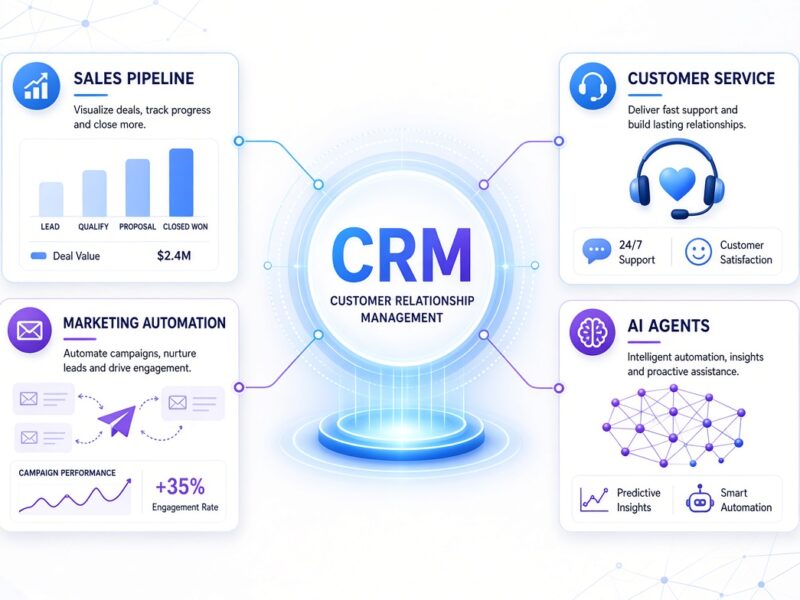
- Review a new inbound lead, enrich the data, score it, and book a meeting if the fit is strong
- Detect a support ticket that matches a known issue and resolve it automatically
- Notice a deal stuck in a stage for too long and draft a personalized follow-up while alerting the rep
- Analyze churn risk signals and trigger a retention sequence
The human remains in control through approval thresholds, guardrails, and audit logs — but the heavy lifting is handled by the system.
Why Agentic CRM Matters Right Now
Several forces converged in 2025–2026 to make this shift inevitable:
- Sales reps still spend only about 40% of their time actually selling
- Customer expectations for instant, personalized responses continue to rise
- Data volumes have grown beyond what humans can process manually
- Generative AI models became reliable enough for production workflows
- Major vendors (Salesforce with Agentforce, HubSpot with Breeze, Microsoft with Copilot agents, Zoho, and others) released production-ready agent platforms
Early adopters report significant lifts in both efficiency and results. Organizations using advanced AI in their CRM are more likely to exceed sales targets and deliver faster service.
Core Capabilities of a Modern Agentic CRM
Not every “AI CRM” is truly agentic. Look for these capabilities:
1. Reasoning and Planning The agent can break a goal into steps, decide the sequence, and adjust if something fails.
2. Tool Use and System Integration It can call external tools, update records, send messages, create tasks, and pull data from other systems.
3. Memory and Context It maintains awareness of the full customer history and previous agent actions.
4. Guardrails and Human Oversight Clear rules for when the agent must ask for approval, escalate, or stop.
5. Observability and Audit Trails Every action is logged so managers can review, correct, and improve the system.
6. Continuous Learning Performance improves as the agent sees more outcomes (with proper feedback loops).
Real Business Benefits
When implemented well, Agentic CRM delivers concrete results:
- Higher sales productivity — Reps spend less time on administrative work and more time on high-value conversations
- Faster response times — Leads and tickets are handled in minutes instead of hours
- Improved consistency — Every customer receives the same high standard of follow-up
- Better forecast accuracy — Agents surface risks and opportunities earlier
- Scalable personalization — Personalized outreach becomes possible at volume
- Reduced operational cost — Routine work that previously required headcount is automated
The biggest advantage is leverage: a smaller team can manage a larger book of business without sacrificing quality.
Important Risks and How to Manage Them
Agentic systems introduce new challenges:
Data quality remains the foundation. Poor data produces poor agent decisions. Hallucinations and errors can damage customer trust if not properly controlled. Over-automation can make interactions feel robotic. Governance and compliance become more complex when AI takes actions. Change management is critical — teams need to trust and supervise the agents.
Best practices include starting with low-risk use cases, setting clear approval thresholds, monitoring agent performance closely in the first months, and keeping humans in the loop for high-stakes decisions.
How to Evaluate and Choose an Agentic CRM Platform
Ask these questions during evaluation:
- Can the agents perform multi-step workflows across systems, or only single actions?
- How transparent is the reasoning process?
- What level of customization and control do you have over agent behavior?
- How strong are the data quality and security features?
- Does the vendor provide pre-built agents for common sales, service, and marketing scenarios?
- What does the total cost look like when agents scale (usage-based pricing is common)?
Leading options in 2026 include Salesforce Agentforce, HubSpot’s agent suite, Microsoft Dynamics 365 with Copilot agents, and several strong mid-market and vertical platforms.
Implementation Roadmap
A practical approach that reduces risk:
- Audit current processes and identify high-volume, low-complexity tasks
- Clean your data before giving agents access
- Start with one or two pilot agents (for example, lead qualification or simple case resolution)
- Define clear success metrics and review them weekly
- Train the team on how to supervise and improve the agents
- Expand gradually once trust and results are established
- Build a governance model for ongoing oversight
Companies that treat Agentic CRM as a capability to develop — rather than a switch to flip — achieve far better outcomes.
The Bottom Line
In 2026, CRM is no longer just about managing relationships. It is about orchestrating intelligent systems that act on behalf of the business while keeping humans in control of strategy and judgment.
Organizations that successfully deploy Agentic CRM gain a structural advantage: they respond faster, operate more efficiently, and deliver more consistent experiences at scale.
The question is no longer whether AI agents will become part of CRM. The question is how quickly your organization will learn to use them effectively.
Those who move with discipline — clean data, clear guardrails, measured rollout, and continuous improvement — will turn customer relationships into a true competitive engine.